Bring an international payment card and some Korean won rather than relying on only one way to pay. Cards are widely used at shops and restaurants, while cash can help with some market purchases and ordinary physical T-money top-ups. Check acceptance before ordering or committing to a purchase.
This guide covers common payment decisions for visitors, not a guaranteed budget or a recommendation for a specific card. Official sources were checked on November 8, 2026; acceptance, fees and machine options can change.
Which payment method should you prepare?
| Situation | Practical starting point | What to check |
|---|---|---|
| Shops, restaurants and hotels | International payment card | Whether the specific merchant and terminal accept your card |
| Traditional markets or small street stalls | Carry some Korean won as a backup | Ask the individual vendor; payment options vary |
| Physical T-money purchase or top-up | Keep Korean won in cash available | Follow the instructions at the convenience store or station machine |
| Getting more won | Exchange money or use a compatible ATM | Opening hours, accepted cards, exchange rate and fees |
The Korea Tourism Organization says cards are accepted at most stores, but some traditional markets and street shops may accept only cash. That does not mean every stall is cash-only or that every overseas card works everywhere. A second payment method is useful if a terminal declines your card.
How much cash do you need?
There is no reliable amount that fits every itinerary. Think through your first journey, whether you will use a physical transit card, and how often you plan to visit markets or small vendors. Carry enough for the cash-only situations you expect and a backup, then withdraw or exchange more if needed.
Your card issuer can explain overseas transaction fees, withdrawal limits and whether your card is enabled for international use. Keep the issuer's support contact somewhere separate from your card and know your PIN before relying on an ATM.
T-money is separate from paying by bank card
An international credit or debit card that works in a shop is not automatically the same thing as a Korean transit card. For ordinary prepaid physical T-money, the Korea Tourism Organization's transport payment guide says to prepare cash for purchase and top-up at convenience stores or subway stations; foreign-issued credit cards are not accepted for that process in its guide.
Other products and machines have different rules. For example, a ticket for an individual train journey is not the same purchase as loading a regular T-money balance. Check the specific product and machine instead of assuming every transit payment needs cash or every card can be topped up the same way.
Exchanging or withdrawing Korean won
Incheon Airport lists exchange services and ATMs, but hours and locations differ. Check the airport's current information for your arrival terminal and whether the selected machine supports your card's network. If you exchange banknotes, check the amount of won you will receive and any stated fee before completing the transaction.
At an ATM, review the withdrawal amount and any displayed charge. Your own bank may also charge a foreign withdrawal or currency conversion fee. The ATM screen cannot necessarily show every fee your issuer will later apply, so check your card's terms before traveling.
If the terminal offers your home currency
Some terminals or ATMs offer to convert the transaction into your home currency. This is called dynamic currency conversion. Visa says the offer should show the exchange rate and any additional fees or markup, and give you a choice to accept or decline it.
Choosing Korean won declines that particular conversion offer; your card issuer's exchange rate and any issuer fees can still apply. Compare the displayed terms with your card's conditions. Paying in won does not guarantee the lowest total cost for every card.
A simple first-day plan
- Before flying, check that your card supports overseas purchases and withdrawals, and review your issuer's fees and PIN requirements.
- Decide how you will get Korean won for expected cash needs, including any ordinary physical T-money top-up.
- At arrival, check the terminal's exchange counter or a compatible ATM if you need cash, and review the amount and charges before confirming.
- When paying, check the amount and currency on the screen. Keep another payment method available if a card or terminal does not work.
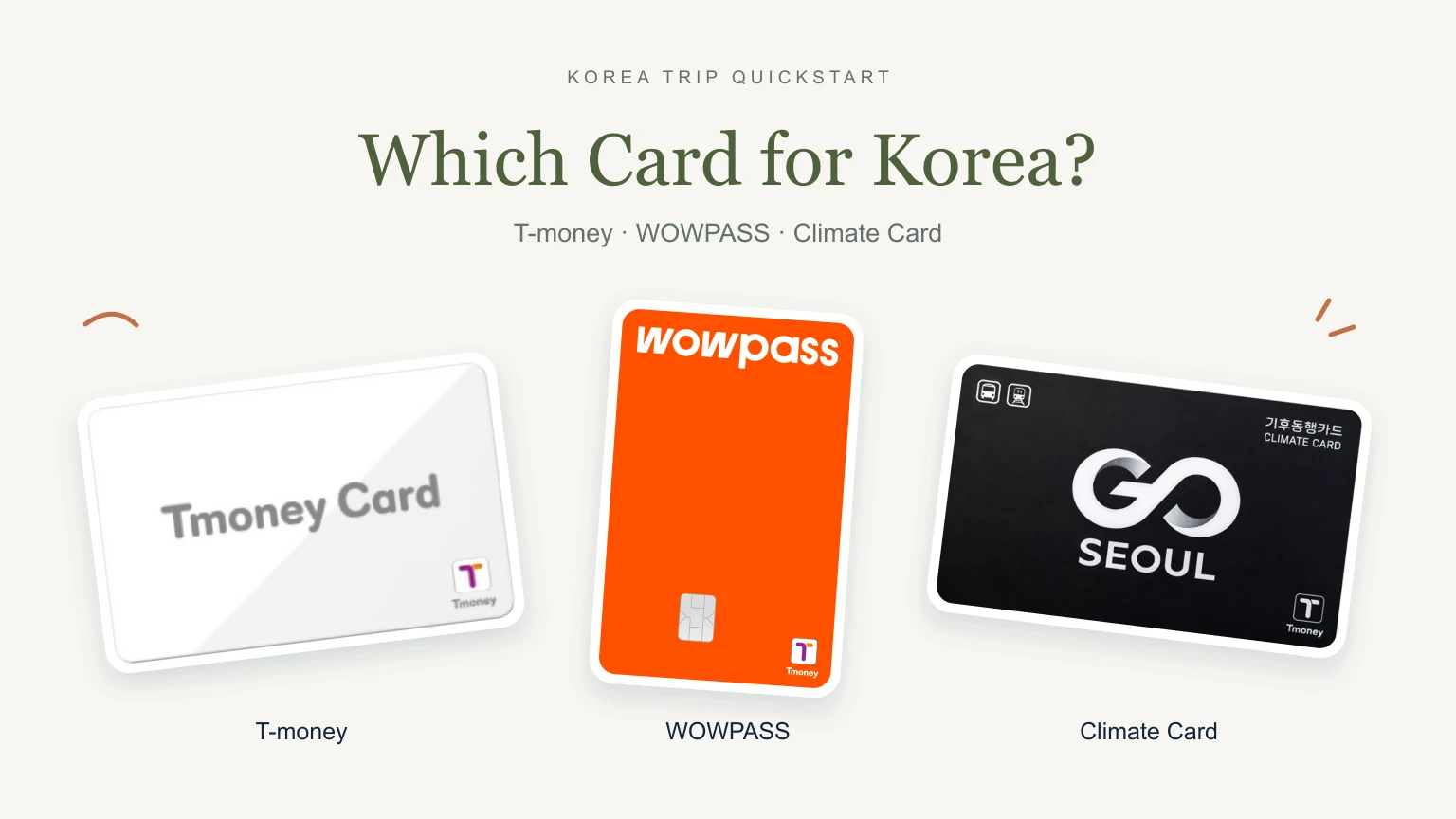
If you are still deciding between T-money, WOWPASS and the Climate Card, the guide below compares what each card is for and explains their different balances and coverage.