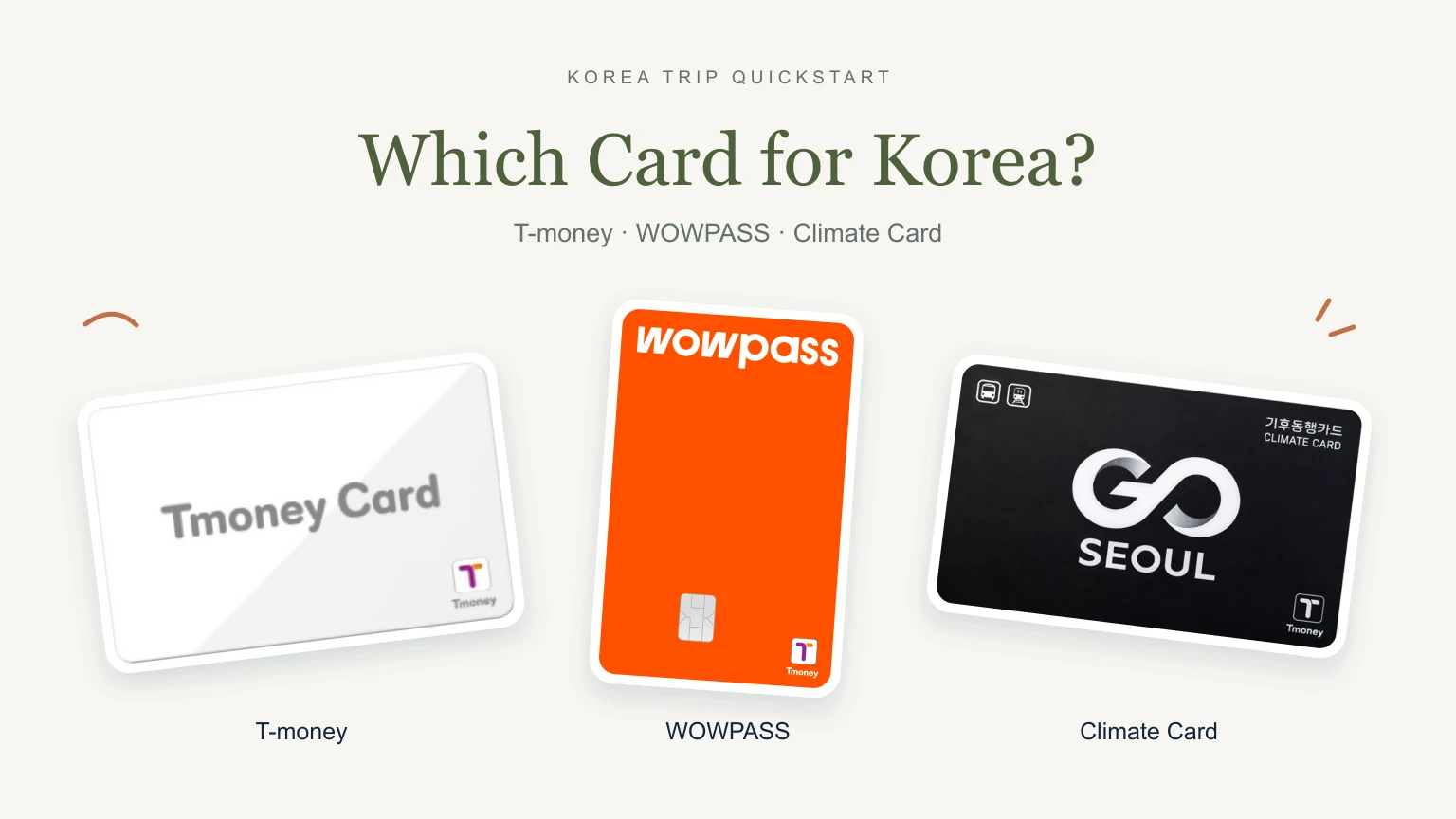
For a first trip to Korea, choose T-money if you mainly need a transport card, WOWPASS if you also want a prepaid card for shopping and meals, or a Climate Card short-term pass if your plans involve frequent rides within its Seoul service area. You do not need all three.
The difference at a glance
| Card | How it works | Best fit |
|---|---|---|
| T-money | Load money and pay fares as you travel | Flexible city travel, including trips beyond Seoul |
| WOWPASS | Prepaid shop payments plus a separately loaded Tmoney function | Travelers who also want a local payment card |
| Climate Card | Unlimited rides on covered services for a selected period | Several days of frequent travel within its Seoul coverage |
This guide compares physical cards for adult visitors. Prices and conditions were checked on November 6, 2026; card artwork and offers can vary.
T-money: the straightforward transport choice
A regular T-money card is a practical starting point if you already have a way to pay for hotels, shops and restaurants. Buy it at a convenience store, load some money and use it on participating buses and subways. The Korea Tourism Organization lists general cards at ₩3,000–₩5,000, with travel money added separately.
It is a more flexible choice than a Seoul-only pass when your itinerary includes other cities. Check acceptance for each service: a transport card does not replace every train ticket or reservation.
You can reload at convenience stores and subway machines. For a physical card, carrying some Korean won for top-ups is a useful backup. Some affiliated shops also accept T-money, but that is different from having a general-purpose payment card.
WOWPASS: useful when you also want a payment card
WOWPASS combines prepaid payments at participating Korean card merchants with a Tmoney transport function. It can suit travelers who want to exchange supported foreign cash or manage a local spending balance in an app. Bring your passport when collecting or issuing the card, and check the current issuance offer before buying.
The shopping balance and the Tmoney balance are separate. Loading the payment side does not automatically make the same amount available at subway gates.
The official service guide describes transferring WOWPASS funds to the card’s Tmoney balance through the app on compatible phones. Cash top-ups at subway stations and convenience stores are another option. Check the Tmoney balance before your first ride.
If transport is your only reason for buying WOWPASS, its built-in Tmoney function may already cover that need; you do not also need a regular T-money card. Compare the fees shown for your chosen top-up or withdrawal method rather than assuming every transaction is free.
Climate Card: compare it with your actual Seoul plans
The tourist short-term passes remain available despite changes to Seoul’s resident-focused monthly products. Current pass prices are:
| Duration | Pass price |
|---|---|
| 1 day | ₩5,000 |
| 2 days | ₩8,000 |
| 3 days | ₩10,000 |
| 5 days | ₩15,000 |
| 7 days | ₩20,000 |
A physical card costs another ₩3,000. The period starts on the recharge date; a one-day pass runs through that day’s last train, rather than for 24 hours after purchase. Load it when you are ready to use it.
Coverage includes Seoul subways and Seoul-licensed city and town buses. Sinbundang, GTX, airport buses and other excluded services need separate payment. Check the official station list before planning a day trip.
For example, a first purchase with a three-day pass totals ₩13,000 before payment fees. If you already own T-money, compare that total with the covered fares you expect to spend over those days. A pass is not automatically cheaper just because your trip lasts three days.
Check your airport journey separately
The Climate Card allows travel from a covered station to Incheon Airport Terminal 1 or 2 on the Airport Railroad, but you cannot board there using it. Arrange another ticket or payment method for the airport-to-Seoul journey.
Seoul’s new machines on Lines 1–8 accept international cards for Climate Card purchases and short-term recharges. The city announced an average service fee of about 3.7%; check the amount before paying. This does not mean every ordinary T-money top-up machine accepts foreign cards.
Choose the card after checking your route
For Seoul plus other cities, start by considering T-money—or WOWPASS if you also want its payment features. For several busy Seoul sightseeing days, check Climate Card coverage and compare the full cost. Keep a separate payment option for excluded journeys.
Look up your hotel, airport transfer and any day trips in a local map app before buying. The route you will actually take is more useful than choosing whichever card has the longest feature list.